Healthy aging is fundamentally defined by an individual’s capacity to interact safely, effectively, and autonomously with their immediate environment. However, progressive musculoskeletal shifts, decreased sensory acuity, and overlapping medical conditions can transform once-automatic movements into complex physical challenges. When an older adult experiences difficulty executing precise motor tasks, the solution is not to compromise their autonomy by taking over their responsibilities. Instead, clinical intervention should focus on modification and neuromuscular adaptation. Utilizing professional occupational therapy services tailored for senior daily living introduces advanced therapeutic strategies that rebuild functional capacity and structurally alter environmental barriers.
A common misconception is that occupational therapy is a passive form of assistance.
In reality, it is an active, evidence-based discipline that applies anatomical and biomechanical principles to human activity. By integrating comprehensive home health care support for adapting routines at home, clinicians perform an operational analysis of how a patient moves, identifying specific physical deficits and implementing systematic changes. This clinical approach ensures that the senior’s physiological energy is preserved, musculoskeletal strain is minimized, and the risk of accidental re-injury is heavily reduced under direct physician oversight.
Deciphering the Threshold: When Physical Fluctuations Demand Intervention
Recognizing the exact transition point between normal age-related slowing and a clear clinical deficit is essential for timely medical intervention. Subtle changes in movement patterns often serve as the earliest warnings that an individual’s physical capabilities no longer match the demands of their environment.
Families must maintain strict vigilance.
| Objective Clinical Indicator | Underlying Physiological Threat | Immediate Evaluative Target |
|---|---|---|
| Noticeable Tremors or Dysmetria | Central nervous system dysfunction or progressive parkinsonian changes | Assessment of fine motor control, object grasping precision, and stability |
| Asymmetrical Weight-Bearing | Severe joint degeneration, structural instability, or hidden tracking pain | Dynamic balance screening, core integration analysis, and transfer biomechanics |
| Increased Task Elongation | Cardiopulmonary deconditioning, cognitive fatigue, or motor planning deficits | Assessment of oxygen tolerance, energy expenditure, and task-sequencing |
Identifying these clear signs a senior may benefit from at-home OT intervention prevents the development of secondary complications, such as joint contractures or severe muscle atrophy caused by immobility. When an older adult consistently exhibits physical guarding during transitional movements or undergoes an unexplained reduction in movement frequency, specialized evaluation is required. Pinpointing exactly when self-care challenges signal the need for occupational therapy allows families to bypass uncoordinated non-medical support, ensuring that an authorized, insurance-reimbursable medical plan of care is initiated immediately.
The Architecture of In-Home Care: Real-World Clinical Adaptation
The primary advantage of home-based rehabilitation lies in the immediate, unmitigated application of therapeutic principles to the patient’s actual living space. Traditional clinic spaces cannot replicate the precise heights, lighting angles, and floor surfaces that a senior must navigate every single day. Understanding how occupational therapy is delivered within the home setting requires viewing the home not as a residential space, but as a specialized rehabilitation zone.
During the initial evaluation, the therapist performs an extensive environmental mapping process.
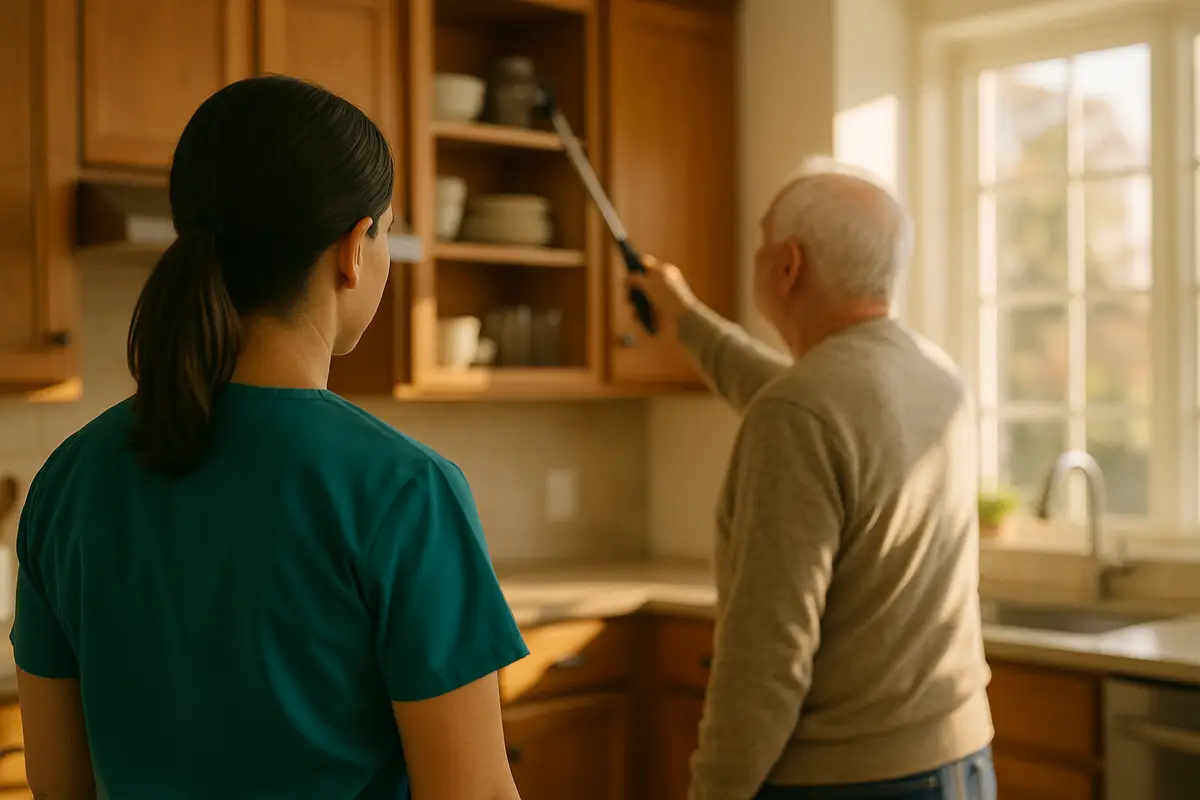
Every architectural feature is analyzed through a kinetic framework. The clinician evaluates how the patient rises from their specific upholstery, analyzes the reach requirements of their workspace layout, and screens for environmental fall hazards like uneven flooring transitions. This detailed environmental modification is a core component of home health care services designed to preserve senior independence, transforming a potentially hazardous house into a structured environment that actively promotes physiological recovery and safe physical movement.
Neurological Adaptation: Managing Advanced Motor Conditions
Progressive neurological disorders introduce complex motor deficits that require highly specialized adaptation strategies. For instance, when a patient faces progressive dopaminergic pathway degeneration, they experience profound physical limitations, including resting tremors, lead-pipe rigidity, and sudden motor freezing.
Effectively adapting daily routines for seniors living with Parkinson’s disease requires implementing specific rhythmic cueing and biomechanical adjustments.
Occupational therapists teach patients to utilize auditory and visual triggers to bypass damaged basal ganglia networks, allowing the brain to initiate movement sequences through alternative cortical pathways. Clinicians also introduce specific weight-shifting exercises that prevent postural instability during lateral transitions. These evidence-based OT strategies for seniors with neurological or cognitive changes focus heavily on neurodevelopmental retraining, ensuring that individuals can safely manage their environment despite the challenges of a progressive disease.
Biological Synchronization: Restoring Physical Function and Structure
Human physiology operates optimally within a framework of predictability and rhythm. When an older adult’s movement patterns become disorganized due to illness or injury, the body experiences accelerated physical deconditioning and heightened systemic stress.
Focusing on building structured routines that support senior wellness establishes a vital foundation for physiological stabilization. Therapists carefully analyze the patient’s metabolic output throughout the day, aligning intensive therapeutic activities with their peak energy windows. This deliberate pacing minimizes the incidence of exertional dyspnea and protects the cardiovascular system from unnecessary stress.
| Rehabilitation Discipline | Foundational Musculoskeletal Target | Collaborative Clinical Outcome |
|---|---|---|
| Physical Therapy (PT) | Gross motor strength, pelvic stabilization, and gait mechanics | Restoring foundational balance, safe ambulation, and stair navigation |
| Occupational Therapy (OT) | Fine motor control, upper extremity precision, and cognitive sequencing | Restoring hand dexterity, tool manipulation, and task mechanics |
Integrating regular physical movement into these structured daily schedules helps activate neurotrophic factors that support long-term memory and cognitive preservation. Utilizing targeted outpatient therapy to improve seniors’ physical functioning ensures that muscle mass is actively preserved and joint lubrication is maintained. These evidence-based practical OT and PT treatment approaches for older adults demonstrate that gross motor strength and fine motor coordination must be trained simultaneously to achieve complete physical rehabilitation.
Achieving Long-Term Autonomy Through Clinical Continuity
As the rehabilitation process progresses, the clinical focus shifts from immediate safety adjustments toward long-term functional mastery. Sustained rehabilitation prevents the physical plateaus that often occur when a patient concludes short-term acute care. Exploring how outpatient therapy transforms daily activity for elderly patients highlights the deep biological changes associated with consistent, goal-directed exercise.
A decline in physical mobility is a significant challenge for an older adult, but it can be managed successfully with a structured clinical plan. By combining advanced biomechanical modifications from occupational therapists, lower-extremity gait retraining from physical therapists, and skilled nursing oversight for cardiovascular tracking, home health care provides a highly effective medical framework. This interdisciplinary approach ensures that seniors can safely navigate their recovery, minimize the risk of re-injury, and confidently maintain their physical autonomy within the safety of their homes.
Frequently Asked Questions
How do occupational therapists help seniors adapt their daily routines?
Occupational therapists assess a senior's physical, cognitive, and environmental challenges and develop personalized strategies to make everyday tasks safer and easier. They may recommend adaptive techniques, exercises, and home modifications to support independence.
What signs indicate that a senior may need occupational therapy?
Common signs include difficulty with fine motor coordination, challenges managing medications safely, increased fall risk, tremors, reduced mobility, prolonged task completion, or executive functioning challenges.
Can occupational therapy help seniors remain independent at home?
Yes. Occupational therapy focuses on improving functional abilities and adapting the home environment so seniors can safely perform daily activities and maintain their independence for as long as possible.
How does occupational therapy support seniors with Parkinson's disease or other neurological conditions?
Occupational therapists teach movement strategies, adaptive techniques, and exercises that help manage symptoms such as tremors, rigidity, balance problems, and difficulty performing daily tasks, improving overall quality of life.
What types of home modifications can occupational therapists recommend?
Occupational therapists may recommend grab bars, improved lighting, non-slip flooring, adaptive equipment, rearranged furniture, and other safety modifications to reduce fall risks and improve accessibility throughout the home.
How does occupational therapy differ from physical therapy for seniors?
Occupational therapy focuses on functional retraining, cognitive exercises, and environmental adaptations to help patients safely navigate their homes, while physical therapy primarily targets gross motor strength, balance, gait training, and overall mobility function.