
Most people picture a fall as a dramatic, obvious event — a slip on a wet floor, a tumble down the stairs. But the falls that quietly reshape an older adult’s life rarely look like that. They happen on the way to the bathroom at 2 a.m. They happen to turn around too fast in the kitchen. They happen stepping off a curb in Larchmont or onto an uneven Brentwood sidewalk that’s been buckled by a tree root for fifteen years.
And here’s the part nobody wants to say out loud: the fall itself often isn’t the worst part. It’s what follows. The fear. The hesitation. The slow, almost invisible shrinking of a person’s world as they start avoiding the stairs, the garden, the walk to the corner — until “being careful” becomes its own kind of decline.
This doesn’t have to be the trajectory. Balance is trainable. Strength is rebuildable. And for a lot of Angelenos, the most effective place to do that work isn’t a clinic across town — it’s the very home where the falls are most likely to happen.
Why Falling Becomes More Likely With Age — It’s Not Just “Getting Old”
There’s a lazy explanation floating around that falls are simply an inevitable part of aging. That’s not true, and believing it is part of the problem. Falls aren’t caused by a birthday. They’re caused by specific, identifiable, and — this is the important word — modifiable factors that tend to accumulate over time.
Several things usually stack up at once:
Muscle loss. Starting in our 30s and accelerating later, we lose muscle mass and power. The legs that used to catch a stumble in a fraction of a second get slower. Strength training reverses a meaningful chunk of this at almost any age.
Balance system changes. Balance is a coordinated effort between the inner ear, the eyes, and sensors in the feet and joints. As these systems dull, the body’s automatic correction gets sluggish. The good news: balance is a skill, and skills respond to practice.
Medication side effects. Dizziness, drowsiness, and blood-pressure dips from common prescriptions are a frequent and overlooked culprit.
Vision and lighting. Reduced depth perception plus a dim hallway is a quiet recipe for a misstep.
Environmental hazards. Throw rugs, cords, clutter, low couches, missing grab bars, and slick bathroom floors — the home itself is often the unindicted co-conspirator.
Notice how many of these are fixable. That’s the entire point. Fall risk isn’t a fixed sentence; it’s a set of dials that a skilled therapist can turn back down.
The Real Cost of Doing Nothing
It’s worth being blunt about stakes, because “I’ll be more careful” is the most common — and least effective — fall-prevention plan there is.
A single serious fall can fracture a hip, trigger a hospital stay, and set off a cascade: surgery, deconditioning from bed rest, loss of independence, and sometimes a permanent move away from home. Even falls without a major injury extract a toll, because the fear they create leads people to move less. Moving less means weaker muscles and worse balance — which makes the next fall more likely, not less. It’s a downward spiral that “being careful” actually feeds.
The way out runs in the opposite direction: deliberately building strength and balance so the body can catch itself, and rebuilding the confidence to keep living fully. That’s exactly what physical and occupational therapy are designed to do.
What In-Home Balance Therapy Actually Involves
This is where home-based care has a structural edge over the clinic. A balance program is only as good as its relevance to the place you’ll use it, and there’s no more relevant place than your own floor plan.
When a licensed therapist comes to the home, the work tends to unfold across a few connected fronts.
A real risk assessment, in the real space. The therapist evaluates strength, gait, and balance — then walks the actual route from the bed to the bathroom, eyes the lighting on the landing, checks the height of the favorite chair, and spots the rug that’s been a hazard for years. A clinic can test your balance; only a home visit can audit your environment.
Targeted strength work. Fall prevention lives in the hips, thighs, ankles, and core. The therapist builds a progressive program to restore the specific power needed to stand up, climb a step, and recover from a stumble — calibrated to where you are now, not a generic chart.
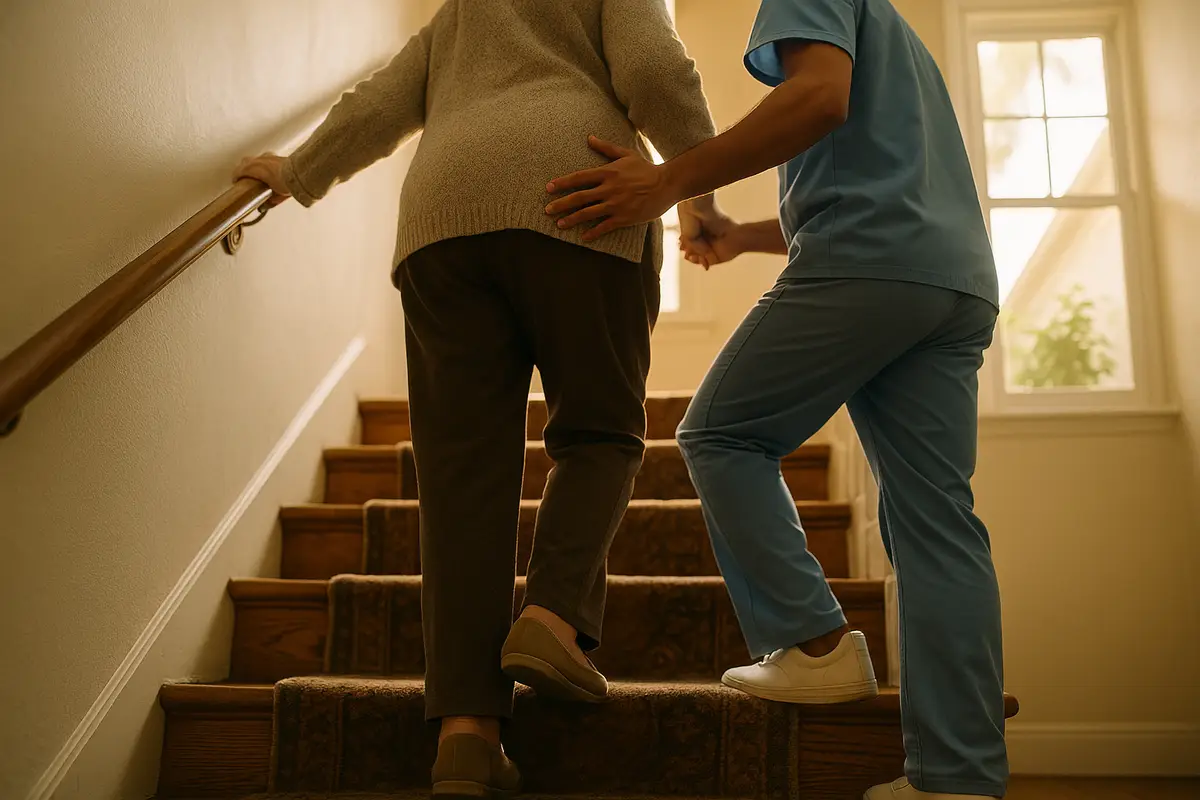
Balance and gait retraining. Through graded exercises, the therapist retrains the body’s correction system — weight shifts, controlled reaching, navigating thresholds and steps, walking on the actual surfaces you walk on daily. Skills practiced where they’ll be used transfer far better than skills learned on a clinic’s flat, uniform floor.
Confidence rebuilding. Practicing the exact movements that frighten you — that specific staircase, that step down to the patio — with an expert at your side methodically dismantles the fear that keeps so many people housebound.
Where Occupational Therapy Fits Into Fall Prevention
Physical therapy rebuilds the body’s capacity to stay upright. Occupational therapy makes the daily routine itself safer — and the two together are far stronger than either alone.
An occupational therapist looks at the tasks where falls cluster and re-engineers them. Getting in and out of the shower. Reaching items without overextending. Managing the morning routine without rushing on unsteady legs. They recommend and train the use of assistive equipment, suggest grab-bar and lighting placement, and reorganize high-use spaces so balance is never put to an unnecessary test.
In other words, PT raises your ceiling for safe movement, while OT lowers the demands of your daily environment to meet you there. You can read more about that functional, daily-life focus on our occupational therapy in Los Angeles page.
Five Myths About Falls Worth Throwing Out
“Falls just happen when you get old.” No — they happen for specific, treatable reasons. Age is a risk factor, not a cause.
“If I move less, I’m safer.” The opposite. Less movement means weaker muscles and duller balance, which raises fall risk. Inactivity is a hazard, not a safeguard.
“Balance can’t be improved at my age.” It can. Balance is a trainable skill, and meaningful gains are well-documented even in adults well into their 80s and beyond.
“I’d need to go to a clinic for real therapy.” Not in California. Direct access lets a licensed physical therapist evaluate and treat you at home, often without a referral. (Some insurers still require one for coverage, and there are visit limits — we verify your benefits up front.)
“It’s too late once you’ve already fallen.” It’s never too late. Recovering strength and confidence after a fall is precisely what therapy is built for, and the sooner it starts, the better the outcome.
Starting Without the Runaround
One of the biggest barriers to fall prevention is also one of the easiest to remove. In California, you generally don’t need a physician’s referral to begin outpatient physical therapy — the state allows direct access, so a licensed therapist can assess and start treating you right away. Some insurance plans still want a referral to pay for the visits, and the law caps how long you can continue before seeing a doctor, so our team checks your specific coverage before anything begins. No surprise bills, no chasing paperwork while your risk quietly climbs.
That speed matters here more than almost anywhere, because fall prevention is fundamentally about acting before the fall — not scrambling to recover after one.
Trusted Care, Delivered to Your Door
When the goal is keeping someone safe in their own home, the credentials of who walks through the door matter. A Plus Care is accredited by the Accreditation Commission for Health Care (ACHC), and our balance and fall-prevention therapy is delivered by licensed, doctorate-level physical and occupational therapists across Beverly Hills, Hollywood, Brentwood, Westwood, and the greater Los Angeles area.
If you’re worried about a parent who’s started gripping the furniture to get around — or you’ve noticed your own confidence on stairs slipping — that’s the signal to act, not to wait. We offer a free 15-minute phone consultation with a Doctor of Physical Therapy to help you understand the risk and the options before committing to anything.
Call 323-918-5505, email info@apluscarela.com, or book your free consultation. The best time to prevent a fall is always before it happens — and the best place to start is right where you live.
Frequently Asked Questions
If I'm afraid of falling, isn't it safer to just move less?
Moving less actually increases your risk. Inactivity leads to weaker muscles and a duller sense of balance, which creates a downward spiral where the next fall becomes more likely. Deliberately building strength and balance is the safest approach.
Is it too late to improve my balance?
It is never too late. Balance is a highly trainable skill, and meaningful improvements are consistently documented in adults well into their 80s and beyond.
Do I need a doctor's referral to start balance therapy in California?
Generally, no. California allows “direct access,” meaning a licensed physical therapist can assess and begin treating you right away without a physician's referral. However, some insurance plans do require one for coverage, so our team will verify your benefits before you begin.
Why is in-home therapy better for fall prevention than going to a clinic?
A clinic can test your balance, but only a home visit can evaluate your actual environment. In-home therapy allows the therapist to spot real hazards (like throw rugs or poor lighting) and lets you practice navigating the exact stairs, chairs, and hallways you use every day.
What is the difference between Physical Therapy and Occupational Therapy for fall prevention?
Physical therapy rebuilds your body's physical capacity, strength, and balance to keep you upright. Occupational therapy re-engineers your daily routines (like getting in and out of the shower) and your environment to make them safer. Together, they provide a comprehensive defense against falls.