
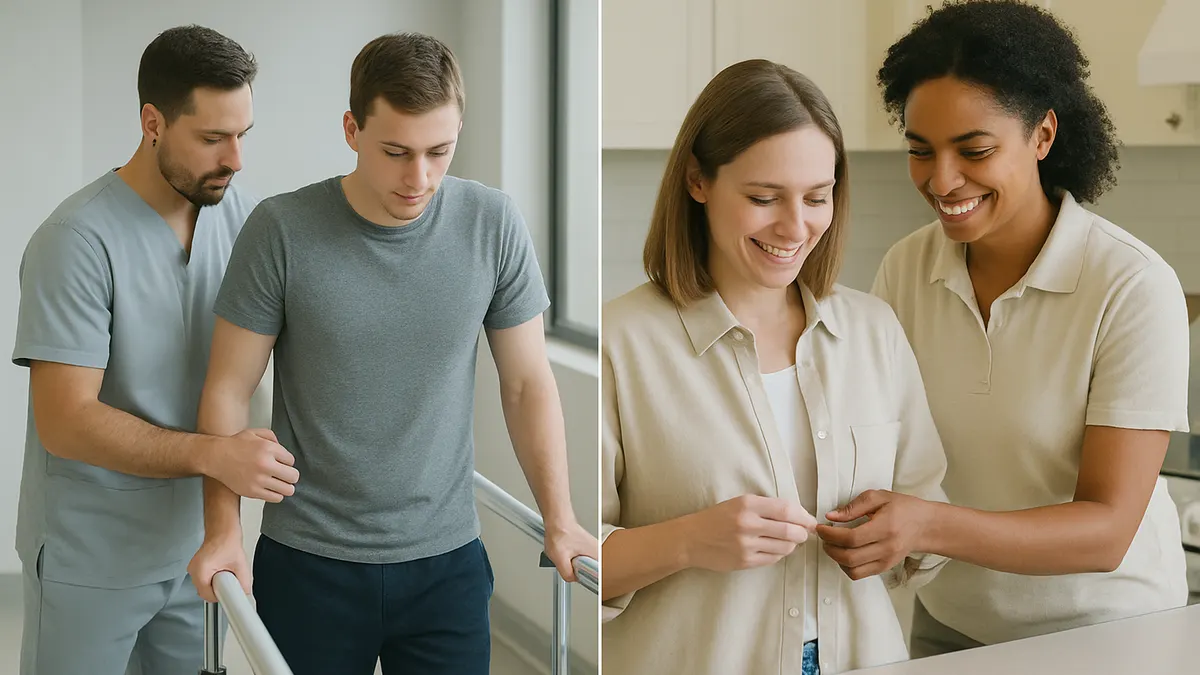
Physical therapy focuses on restoring movement, strength, and pain-free function, while occupational therapy focuses on providing skilled training that restores the daily living skills people need to function safely and independently, from adaptive bathing and dressing techniques to safe meal preparation and medication management. Both professions often work together after surgery, illness, or injury, but a physical therapist typically targets the body’s mechanics, and an occupational therapist typically targets a person’s everyday activities.
Quick Answer at a Glance
- Physical therapy (PT) rebuilds strength, balance, flexibility, and mobility after injury, surgery, or illness.
- Occupational therapy (OT) rebuilds the skills needed for daily living, such as dressing, cooking, bathing, and managing a household.
- PT often comes first after a major medical event; OT frequently follows or runs alongside it to translate physical gains into real-world independence.
- Both are licensed healthcare professions requiring a graduate degree and state licensure.
- Many patients, especially older adults recovering at home, benefit from both PT and OT working as a coordinated team.
What Is Physical Therapy?
Physical therapy is a licensed healthcare profession centered on the body’s ability to move. A physical therapist evaluates strength, range of motion, balance, gait, and pain patterns, then designs a treatment plan built around targeted exercise, manual therapy, and functional training. The goal is almost always the same: reduce pain, rebuild strength, and restore the mechanical function a person needs to stand, walk, climb stairs, or return to physical activity.
Physical therapists hold a Doctor of Physical Therapy (DPT) degree and must pass a national licensing exam before treating patients. Common reasons someone might work with a physical therapist include recovering from joint replacement surgery, healing after a fall, managing chronic back or neck pain, or regaining balance after a stroke. For a closer look at how this plays out in a home setting, the benefits in-home physical therapy offers older adults are especially relevant for seniors who want to avoid unnecessary trips to an outpatient clinic.
What Is Occupational Therapy?
Occupational therapy takes a different starting point. Instead of asking “how do I move better,” an occupational therapist asks “what do you need to do, and how can we get you doing it safely again.” Occupational therapists work on the fine motor skills, cognitive function, visual processing, and adaptive strategies people rely on for what clinicians call activities of daily living, or ADLs: bathing, dressing, meal preparation, and medication management.
Occupational therapists earn a master’s or doctoral degree and, like physical therapists, must hold a state license. Their sessions might involve practicing how to safely step into a shower, relearning how to button a shirt after a stroke, adapting a kitchen for someone with limited hand strength, or building routines that support memory and attention after a cognitive decline. Anyone weighing whether this kind of support fits their situation can review a guide to occupational therapy delivered at home for a fuller picture of what a typical care plan includes.
Physical Therapy vs Occupational Therapy: Key Differences
The table below breaks down how these two professions differ in focus, setting, and outcome.
| Category | Physical Therapy | Occupational Therapy |
| Primary focus | Movement, strength, balance, pain | Daily living skills and independence |
| Typical goals | Walk further, climb stairs, reduce pain | Dress independently, cook safely, manage a home |
| Common tools | Therapeutic exercise, manual therapy, gait training | Adaptive equipment, task retraining, cognitive strategies |
| Who benefits most | Post-surgical patients, fall risk, chronic pain | Stroke survivors, arthritis, cognitive or vision changes |
| Degree required | Doctor of Physical Therapy (DPT) | Master’s or Doctoral degree in Occupational Therapy |
While the table simplifies things, real recovery rarely fits into one column. Someone recovering from a hip replacement, for example, needs PT to rebuild the strength and range of motion in the joint, and OT to relearn how to get in and out of a car or bathtub without re-injuring it. This overlap is exactly why joint replacement rehabilitation roles for physical and occupational therapists are usually planned together rather than treated as separate tracks.
How Physical Therapy and Occupational Therapy Work Together
In practice, PT and OT rarely operate in isolation. After a major medical event, such as a stroke, hip fracture, or extended hospital stay, a physical therapist and occupational therapist often coordinate as part of the same care team, sometimes alongside a home health nurse or speech therapist. The physical therapist works on standing balance and walking distance, while the occupational therapist focuses on translating that improved mobility into real tasks, like reaching a shower safely or preparing a simple meal without fatigue.
This combined approach matters most for older adults recovering at home, where the goal is not just clinical improvement but the confidence to manage daily life without a caregiver present at every moment. Coordinated care also reduces the risk of falls and hospital readmission, since both therapists are watching for the same warning signs from two different angles. Families in this part of Los Angeles can see how this looks in practice through home health care services available in West Hollywood, where PT and OT visits are scheduled around a single recovery plan.
Signs You Might Need Physical Therapy
Certain symptoms and situations point more clearly toward physical therapy:
- Ongoing pain in the back, neck, hip, or knee that limits daily movement
- Balance problems or a recent fall
- Recovery needs after joint replacement, spine surgery, or a fracture
- Muscle weakness after a hospital stay or extended bed rest
- Difficulty walking, climbing stairs, or getting up from a chair unassisted
Anyone unsure what a first appointment looks like can review what a first in-home physical therapy session involves before scheduling one.
Signs You Might Need Occupational Therapy
Occupational therapy tends to be the better fit when daily tasks, rather than movement alone, have become difficult:
- Trouble dressing, bathing, or grooming independently
- Difficulty preparing meals, managing medication, or handling household chores
- Reduced hand strength, coordination, or fine motor control
- Memory, attention, or problem-solving changes after a stroke or cognitive decline
- A home environment that no longer feels safe to navigate
Families supporting a parent through this transition often find it helpful to read how adapting daily routines with occupational therapy support can rebuild a sense of independence at home.
What to Expect During an In-Home PT or OT Evaluation
For patients receiving care at home rather than in a clinic, the first visit typically follows a predictable pattern:
- Initial assessment. The therapist reviews medical history, current symptoms, and personal goals, then evaluates strength, mobility, or daily function depending on the discipline.
- Home safety review. For OT especially, the therapist walks through the home looking for fall risks, awkward step heights, or equipment that could make daily tasks easier and safer.
- Goal setting. The therapist and patient agree on specific, measurable goals, such as walking to the mailbox unassisted or preparing a simple breakfast independently.
- Treatment plan and frequency. A schedule of visits is set based on the severity of the condition and the pace of recovery, with adjustments made as progress is tracked.
- Ongoing progress checks. Therapists reassess regularly and update the plan as strength, mobility, or independence improves.
Why In-Home Therapy Makes a Difference
Receiving physical or occupational therapy at home, rather than commuting to an outpatient clinic, removes a real barrier for people who are already dealing with pain, fatigue, or limited mobility. It also gives therapists a more accurate picture of the environment a patient actually lives in, which matters enormously for occupational therapy in particular. A shower with a high step-in, a narrow hallway, or stairs without a handrail are the kinds of details that only show up during an in-home visit, and addressing them directly tends to produce faster, more lasting independence than generic advice given in a clinic setting. Residents exploring occupational therapy tailored to West Hollywood households can see how these home-specific adjustments are built directly into a plan of care.
Choosing the Right Path for Recovery
Physical therapy and occupational therapy solve two different problems that often appear together: the ability to move, and the ability to live independently once that movement returns. Rather than choosing one over the other, most people recovering from surgery, illness, or a health setback benefit from understanding how the two disciplines complement each other, and from working with a team that coordinates both. A Plus Care brings physical and occupational therapists together as part of one in-home care plan, so recovery addresses both the body and the daily routines that depend on it.
Proudly serving Beverly Hills, Brentwood, Downtown LA, Hollywood, Palms, Sawtelle, West Hollywood, Westwood, Arlington Heights, and Beverly Grove..
Frequently Asked Questions
Is occupational therapy the same as physical therapy?
No, they are related but distinct professions. Physical therapy focuses on movement, strength, and pain, while occupational therapy focuses on skilled training in the daily living activities patients need to relearn, such as safe dressing techniques, bathing safety, and meal preparation.
Can a patient receive both PT and OT at the same time?
Yes, many patients receive both simultaneously, especially after surgery, a stroke, or a hospital stay, since the two disciplines address different but complementary aspects of recovery.
Which comes first after surgery, PT or OT?
It depends on the procedure and the patient's needs, but physical therapy often begins first to restore basic movement, with occupational therapy following or running in parallel to rebuild independence in daily tasks.
Do occupational therapists help with mental or cognitive health?
Yes, occupational therapists commonly work with patients experiencing memory loss, attention difficulties, or cognitive decline, building routines and strategies that support safer, more independent daily living.
How long does a typical PT or OT program last?
Program length varies widely based on the condition, but many home-based plans run several weeks to a few months, with progress reassessed regularly to adjust frequency and goals.
Is in-home physical or occupational therapy covered by insurance?
Many home health PT and OT services are covered by Medicare and private insurance when ordered by a physician and provided by a licensed, accredited agency, though coverage details vary by plan.
What qualifications do physical and occupational therapists have?
Physical therapists hold a Doctor of Physical Therapy degree, and occupational therapists hold a master's or doctoral degree in occupational therapy; both must pass a national exam and hold a state license.
Who decides whether a patient needs PT, OT, or both?
A physician typically orders the appropriate therapy based on a medical evaluation, though therapists themselves often recommend adding the other discipline once they identify needs outside their own scope.