
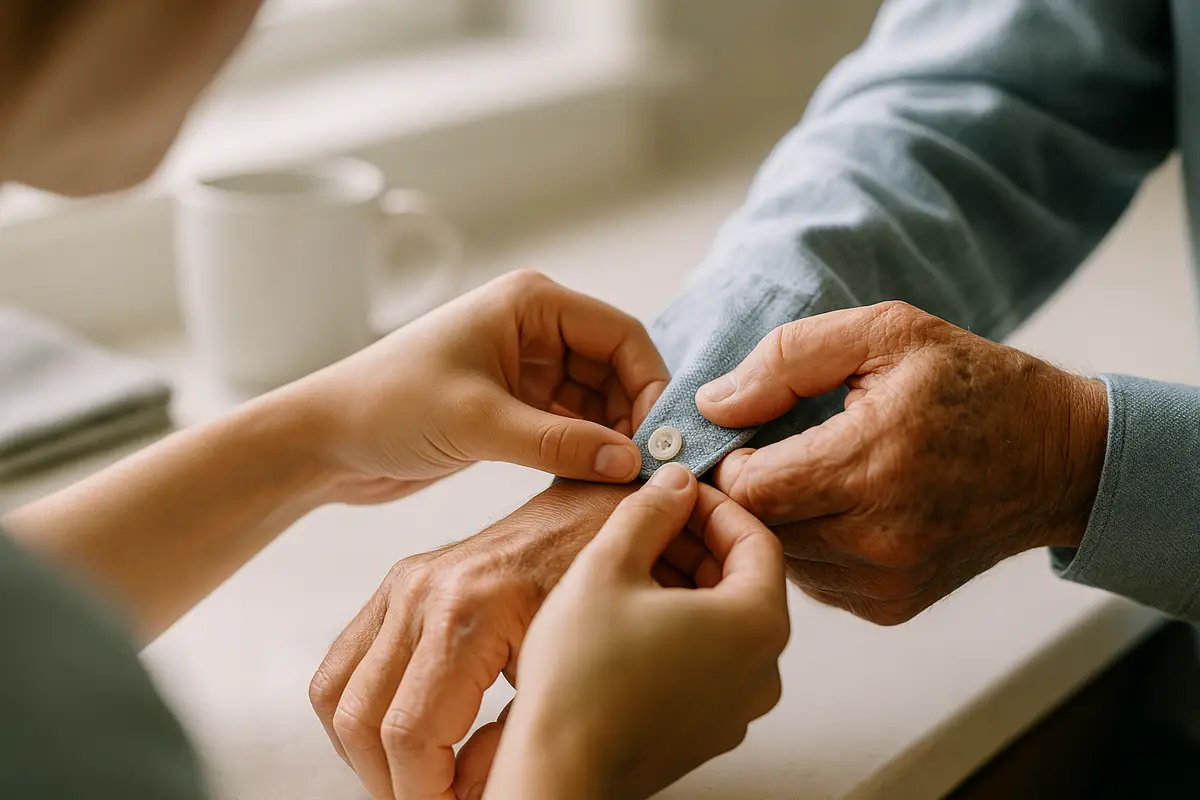
Ask someone what they miss most after a stroke, a bad fall, or a flare of arthritis, and they rarely mention something dramatic. They miss buttoning their own shirt. Making coffee without spilling it. Signing their name so it looks like their name. Getting in and out of the shower without bracing for disaster. Holding a fork steadily through a whole meal.
These small acts are what occupational therapists call your occupations — the ordinary tasks that fill a day and quietly add up to a life. When illness or injury takes them away, what’s lost isn’t just function. It’s independence, dignity, and the feeling of being yourself.
Mobile occupational therapy exists to give those things back — and it does its best work in the one place where those tasks actually happen: your home. Here’s what occupational therapy really is, who it helps, and why having it delivered to your door changes the outcome.
What Is Occupational Therapy — and How Is It Different From Physical Therapy?
This is the question OTs answer most often, so let’s settle it cleanly.
Physical therapy rebuilds the body’s raw capacity — strength, balance, range of motion, walking. Think of it as restoring the engine.
Occupational therapy takes that capacity and channels it into the specific tasks of daily life — dressing, grooming, cooking, writing, managing fine motor work. Think of it as making sure you can actually drive the car through a normal day.
An occupational therapist is a master’s- or doctorate-level clinician trained to analyze the tasks of your daily life, pinpoint exactly where they break down, and rebuild your ability to do them — through targeted exercise, smarter technique, adaptive equipment, and sensible changes to your environment. The two disciplines often work side by side; you can see how they fit together in our outpatient therapy at home program.
Who Mobile Occupational Therapy Helps Most
OT is remarkably versatile, but a few situations call for it especially clearly.
Stroke recovery. A stroke can disrupt the use of a hand or arm, coordination, and the ability to sequence everyday tasks. OT retrains those skills — often relearning how to dress, eat, write, and manage self-care — and adapts the home so progress is possible at every stage.
Arthritis and chronic hand conditions. When grip weakens and joints ache, OTs teach joint-protection techniques, recommend adaptive tools that reduce strain, and preserve the fine motor control needed for buttons, jars, keys, and pens.
Recovery after surgery or hospitalization. Once someone is home but not yet back to full function, OT closes the gap — restoring the ability to bathe, dress, and move through the day safely and independently.
Neurological and cognitive conditions. For people managing the effects of Parkinson’s, dementia, or brain injury, OT supports memory strategies, safe routines, and the practical adaptations that keep daily life manageable.
Hand and upper-limb injuries. From fine motor retraining to dexterity work, OT rebuilds the precise control that hands depend on.
Why “In Your Home” Is the Whole Point of OT
Of all the rehab disciplines, occupational therapy gains the most from being delivered at home — and the reason is simple. The entire purpose of OT is to restore real-world function, and the real world is your actual kitchen, your actual bathroom, your actual closet.
A clinic can teach you a dressing technique on a generic chair. A home OT teaches it in the exact spot where you get dressed every morning, with your actual clothing and your actual furniture. A clinic can suggest a grab bar in theory. A home OT measures your shower, identifies your hazards, and trains you on your setup.
That’s not a convenience upgrade — it’s a clinical advantage. Skills practiced in the environment where they’ll be used transfer far more reliably than skills rehearsed somewhere artificial. When the therapy room is your home, the gap between “I can do this in therapy” and “I can do this in my life” disappears.
A home-based OT typically delivers:
- A functional assessment of your real daily routine — watching how you actually move through your morning and your home
- Task-specific retraining in the spaces where each task lives
- Adaptive equipment recommendations and training so the right tools make hard tasks manageable
- Home safety and modification guidance — lighting, layout, and access adjustments that reduce risk
- Fine motor and coordination work tied directly to the tasks that matter to you
You can explore the full scope on our dedicated occupational therapy in Los Angeles page.
The “No Referral” Advantage — Start Recovering Sooner
Here’s a point that catches many families by surprise: in California, you generally don’t need a physician’s referral to begin outpatient therapy. The state allows direct access, so a licensed therapist can evaluate and start treating you without waiting on referral paperwork.
For occupational therapy, that speed is meaningful. Daily-living skills are easiest to rebuild before unhelpful habits and compensations harden into place. Starting promptly — instead of losing weeks to a referral and scheduling — often means a faster, fuller return to independence.
An honest note: some insurance plans still require a referral to cover the visits, and direct access has limits under California law. Our team verifies your specific benefits up front, so you know exactly what’s covered before the first session — no surprises. For the regulatory background on therapy practice in the state, the California Board of Occupational Therapy is the authoritative source.
How Families Can Tell It's Time to Call an OT
Loved ones often spot the signals before the person does. It may be time to consider occupational therapy if you notice someone:
- Avoiding tasks they used to do easily — dressing, cooking, writing
- Struggling with buttons, jars, utensils, or other fine motor work
- Becoming unsteady or fearful during bathing and self-care
- Withdrawing from routines after a stroke, surgery, or hospital stay
- Relying more and more on others for the basics of daily life
None of these are signs to “just accept.” They’re signs that the right therapy could restore independence — and the sooner that work begins, the more there is to regain.
Reclaim the Tasks That Matter Most
Independence is built from small things — a buttoned shirt, a steady cup of coffee, a signature that still looks like yours. Mobile occupational therapy from A Plus Care helps you rebuild those moments in the place they belong: your own home, on your own schedule, with no referral required to begin in California. We proudly provide convenient in-home occupational therapy services for individuals and families across Beverly Hills, Hollywood, Brentwood, Westwood, Beverly Grove, and Arlington Heights, making personalized care more accessible where you live.
A Plus Care — accredited by the Accreditation Commission for Health Care (ACHC)
- 12100 Wilshire Blvd STE 800, Los Angeles, CA 90025
- 323-918-5505
- info@apluscarela.com
Book your free 15-minute phone consultation with a Doctor of Physical Therapy and take the first step back to doing the things you love.
Frequently Asked Questions
What's the difference between occupational therapy and physical therapy?
Physical therapy rebuilds strength, balance, and mobility — the body's raw capacity. Occupational therapy applies that capacity to real daily tasks like dressing, grooming, cooking, and writing. They often work together, with PT restoring movement and OT translating it into everyday independence.
Do I need a referral to start occupational therapy in California?
California allows direct access, so a licensed therapist can begin evaluation and treatment without a physician's referral. Some insurance plans still require a referral for coverage, and there are limits under state law. A Plus Care verifies your benefits before you start.
Can occupational therapy really be done at home?
Yes — and home is often the ideal setting. Because OT restores real-world daily function, practicing in your actual kitchen, bathroom, and closet makes the skills transfer far more reliably than clinic rehearsal does.
What conditions does mobile occupational therapy help with?
Common reasons include stroke recovery, arthritis and hand conditions, recovery after surgery or hospitalization, neurological and cognitive conditions, and upper-limb injuries.
What areas of Los Angeles does A Plus Care serve?
Mobile occupational therapy is available across the Westside and central LA, including Beverly Hills, Hollywood, Brentwood, Westwood, Beverly Grove, and Arlington Heights.