
You don’t have to be a pro athlete to get a sports injury. You twisted a knee on a Saturday hike up Runyon Canyon. Your shoulder seized up halfway through a Pilates class in Silver Lake. Your lower back announced itself after one too many sets at the gym, or one too many hours hunched over a laptop in a Culver City office. The injury is real — but so is your calendar, and “spend two afternoons a week sitting in a clinic waiting room across town” simply isn’t on it.
This is the exact gap that mobile physical therapy fills for active Angelenos. A licensed physical therapist comes to your home, your building’s gym, or wherever you train — and rebuilds you on your schedule, in your environment, without the referral runaround. Here’s how it works and why it’s become the go-to recovery path for busy, active people across LA.
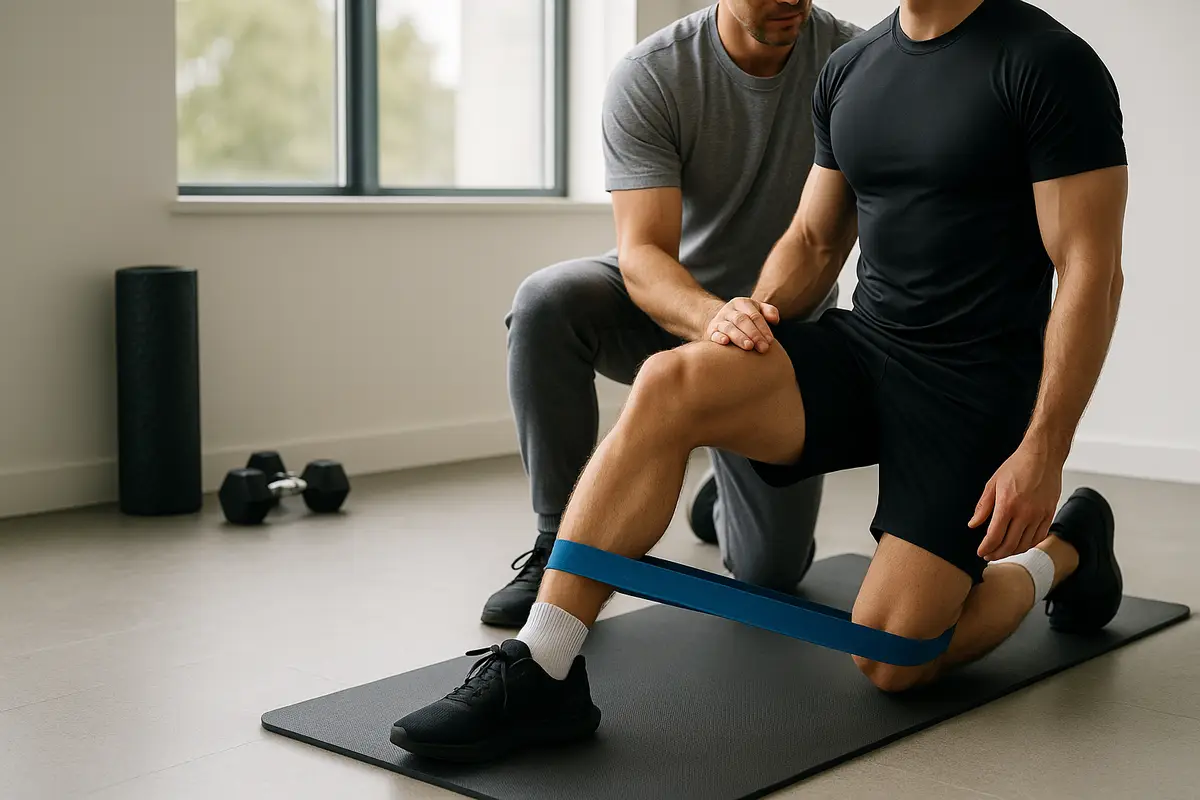
Why Active People in LA Are Switching to In-Home Sports Rehab
The traditional model asks a lot of someone with a full life. Find a clinic. Get a referral. Wait for an opening. Fight traffic on the 10 or the 405. Find parking. Sit in a shared treatment room while one therapist rotates between three patients. Repeat twice a week for six weeks.
Mobile physical therapy collapses that friction. The session comes to you, it’s one-on-one for the entire hour, and it slots into the gaps in a real workday — early morning before meetings, midday between calls, or evening after work. For people whose biggest barrier to recovery isn’t motivation but time, that single change is often what gets them to actually finish a rehab program instead of abandoning it halfway.
There’s a clinical upside too. When your therapist treats you where you actually move — your home gym, your apartment stairs, the spot where the injury happened — the rehab is built around your real mechanics, not a generic clinic setup.
Common Sports & Activity Injuries Treated With Mobile PT
Mobile physical therapy is well-suited to the everyday injuries that sideline active people across the city:
- Knee injuries — runner’s knee, IT band syndrome, ligament strains, and post-op ACL or meniscus rehab
- Shoulder problems — rotator cuff strains, impingement, and post-surgical recovery
- Ankle sprains and chronic instability from hiking, court sports, or trail running
- Lower-back pain from lifting, posture, or repetitive strain
- Tendinopathies — Achilles, patellar, and tennis/golfer’s elbow
- Overuse injuries from ramping up training too fast
Whether the goal is getting back on the Strand for a run or simply lifting a kettlebell without wincing, the work is the same: reduce pain, restore mechanics, rebuild strength, and prevent the re-injury that catches so many people who return too soon.
What Happens in a Mobile Sports-Rehab Session
A strong program moves through clear phases, and a home setting supports each one.
1. Movement assessment. Your physical therapist — a doctorate-level movement expert — evaluates the injured area and the whole kinetic chain around it. A cranky knee is often a hip or ankle problem in disguise. They watch how you actually move, not just where it hurts.
2. Hands-on treatment. Sessions can include manual therapy, soft-tissue work, joint mobilization, and targeted techniques to calm pain and restore range of motion.
3. Progressive loading. This is where rehab succeeds or fails. The therapist rebuilds strength in a graded, structured way — enough to drive adaptation, never enough to flare the injury. Done in your own space, with your own equipment when possible.
4. Sport-specific return-to-activity training. The final phase rehearses the actual demands of your sport — cutting, jumping, lifting, running mechanics — so you come back resilient, not fragile.
5. Re-injury prevention. You leave with a maintenance plan and a corrected movement pattern, so the same injury doesn’t keep recurring.
For a broader look at how physical therapy fits alongside occupational and speech therapy, see our outpatient therapy at home program.
The “No Referral” Advantage for Injuries That Can't Wait
Here’s the detail that matters most when you’re injured and motivated to fix it fast: in California, you generally don’t need a physician’s referral to start outpatient physical therapy. The state allows direct access, meaning a licensed PT can evaluate and begin treating you right away — no waiting on a doctor’s appointment just to be told “yes, go do PT.”
For an active person, that’s the difference between starting rehab while the injury is fresh and easiest to fix, versus losing two weeks to scheduling logistics while tissue stiffens and compensations set in. Early intervention is one of the strongest predictors of a clean recovery.
An honest caveat: some insurance plans still require a referral to reimburse the visits, and California law caps how long you can continue under direct access before seeing a physician. Our team verifies your specific benefits up front, so you know exactly where you stand before the first session — no surprise bills. For the official rules on direct access in California, the Physical Therapy Board of California is the authoritative source.
Mobile PT vs. Telehealth vs. Clinic — Which Is Right for a Sports Injury?
It’s worth being straight about the trade-offs.
Telehealth PT is convenient and fine for guided exercise check-ins, but it can’t deliver hands-on manual therapy or feel how a joint is actually moving. For an acute or hands-on injury, that’s a real limitation.
Clinic-based PT offers heavy specialized equipment that matters in advanced strength-and-conditioning phases. The cost is your time, traffic, and shared therapist attention.
Mobile PT delivers true hands-on, one-on-one treatment in your environment, on your schedule, with no commute — ideal for the assessment, recovery, and return-to-activity phases of most sports injuries. Many active patients use mobile PT for the bulk of their rehab and visit a clinic only if they reach a phase that genuinely needs the big machines. A good therapist will tell you honestly which setting fits your stage.
Get Back to What You Love — Faster
An injury shouldn’t mean choosing between your recovery and your life. With mobile physical therapy from A Plus Care, expert, hands-on rehabilitation comes to you—on your schedule, in your space, with no referral required to begin in California. We proudly provide in-home physical therapy services throughout Beverly Hills, Hollywood, Brentwood, Westwood, Beverly Grove, and Arlington Heights, making it easier to receive personalized care without leaving the comfort of your home.
A Plus Care — accredited by the Accreditation Commission for Health Care (ACHC)
- 12100 Wilshire Blvd STE 800, Los Angeles, CA 90025
- 323-918-5505
- info@apluscarela.com
Book your free 15-minute phone consultation with a Doctor of Physical Therapy and let’s build your comeback.
Frequently Asked Questions
Do I need a referral to start physical therapy for a sports injury in California?
For treatment, no — California's direct-access law lets a licensed physical therapist evaluate and treat you without a physician's referral. Some insurance plans still require a referral for coverage, and there are visit limits in the law. A Plus Care verifies your benefits before you begin.
How soon after an injury should I start physical therapy?
Generally, the sooner the better. Early treatment helps control pain, prevent compensations, and protect range of motion. Because direct access removes the referral wait, you can often start while the injury is still fresh and most responsive.
Can mobile physical therapy really treat sports injuries as well as a clinic?
For the assessment, hands-on treatment, recovery, and return-to-sport phases — yes. Mobile PT delivers full one-on-one care in your environment. Only certain advanced equipment phases may call for a clinic, and your therapist will advise if you reach that point.
What areas of Los Angeles does A Plus Care serve?
Mobile physical therapy is available across the Westside and central LA, including Beverly Hills, Hollywood, Brentwood, Westwood, Beverly Grove, and Arlington Heights.
Will my insurance cover mobile physical therapy?
Often, yes — coverage depends on your plan. Our team verifies your benefits up front so there are no surprises about referrals or out-of-pocket costs.