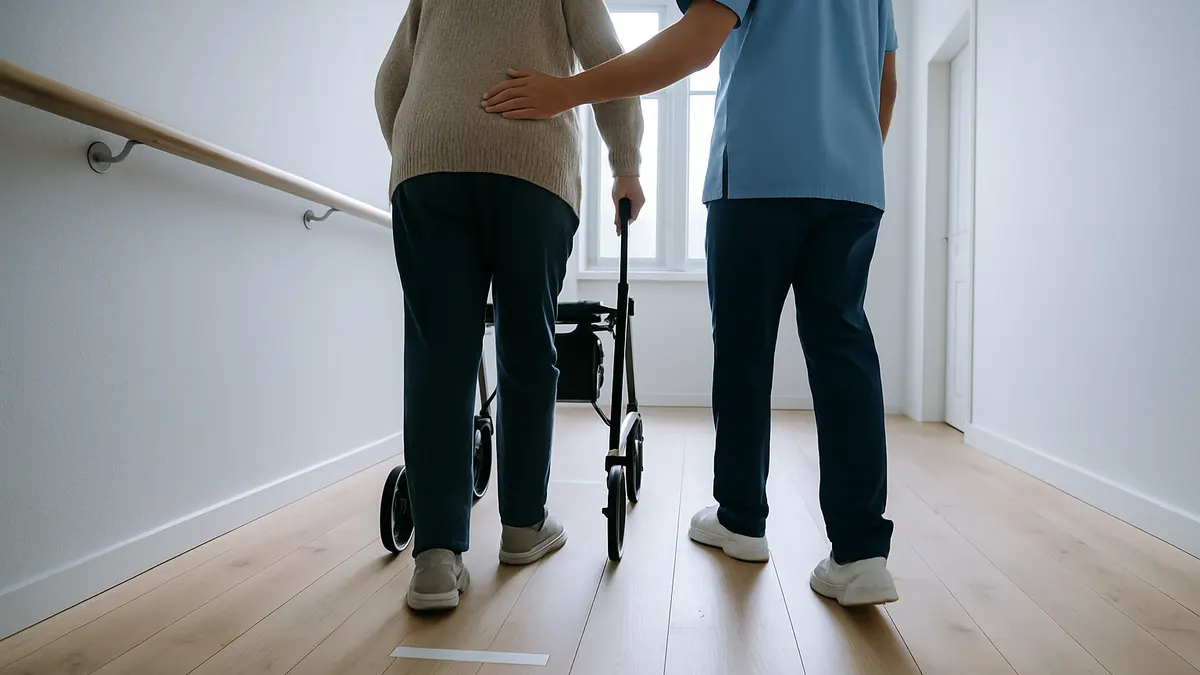
Gait training is a physical therapy treatment that helps people walk more safely and efficiently after an injury, surgery, stroke, or a condition such as Parkinson’s disease. A licensed physical therapist evaluates how a person stands, steps, and shifts their weight, then designs a personalized program of strength, balance, and coordination exercises to correct unsafe walking patterns and reduce the risk of falling.
What Is Gait Training?
Gait is the medical term for the pattern of a person’s walk, including stride length, posture, rhythm, and balance. When an injury, illness, surgery, or neurological condition disrupts that pattern, walking can become slow, uneven, painful, or unsafe. Gait training is a structured form of physical therapy that focuses specifically on retraining the muscles, joints, and nervous system involved in walking.
During gait training, a physical therapist studies exactly how a patient moves, identifies the source of the problem — whether that is weakness, poor balance, joint stiffness, or a neurological deficit — and builds a step-by-step plan to correct it. The goal is not just to help someone walk again, but to help them walk confidently, safely, and with as little pain as possible.
Common Causes of Walking and Balance Problems
Difficulty walking rarely has a single cause. Some of the most common reasons people need gait training include:
- Stroke or other neurological events that affect muscle control
- Parkinson’s disease, which often causes shuffling steps and freezing
- Hip or knee replacement surgery
- Muscle weakness after a hospital stay, illness, or extended bed rest
- Peripheral neuropathy that reduces sensation in the feet
- Age-related decline in strength, vision, or coordination
Signs It Might Be Time for Gait Training
Some warning signs are easy to miss because they develop gradually. It may be worth asking a physical therapist about gait training if you or a loved one notice:
- Holding onto walls or furniture while walking indoors
- Taking smaller, more hesitant steps than in the past
- Feeling unsteady turning around or standing up from a chair
- A recent fall, near-fall, or a growing fear of falling
- Ongoing weakness or pain that changes the way a person walks
Catching these patterns early, before a fall causes an injury, is one of the most effective ways to preserve independence.
Key Benefits of Gait Training
- Reduced risk of falls and fall-related injuries
- Improved strength, balance, and coordination
- Greater confidence moving around the home
- Less reliance on caregivers for daily mobility
- Faster, safer recovery after surgery or hospitalization
- Better day-to-day management of neurological conditions like Parkinson’s disease
Who Can Benefit From Gait Training?
Gait training is appropriate for a wide range of patients, including those recovering from stroke, joint replacement, or a hospital stay, as well as people managing Parkinson’s disease, multiple sclerosis, or peripheral neuropathy. It is also valuable for older adults who have started walking more slowly or cautiously out of a fear of falling, even without a specific diagnosis.
Because walking safely often overlaps with everyday tasks like bathing, dressing, and moving around the kitchen, gait training frequently works alongside therapy focused on rebuilding daily living skills, giving patients a more complete path back to independence at home. For patients managing ongoing dizziness alongside unsteady walking, vestibular rehabilitation for balance disorders is a related area worth asking a therapist about.
What to Expect During a Gait Training Session
- Warm-up: Gentle stretching and range-of-motion exercises prepare the muscles and joints for movement.
- Strength and balance work: Targeted exercises address the specific weaknesses identified in the initial assessment.
- Walking practice: The therapist guides the patient through walking drills, adjusting pace, surface, and distance as tolerated.
- Real-life movement: Sessions often include practicing stairs, transfers, or the specific paths a patient walks at home.
- Home exercise program: Patients typically leave with exercises to continue between sessions, reinforcing progress.
Sessions are adjusted continuously as strength and confidence improve, so the plan a patient starts with rarely looks the same as the one they finish with.
Gait Training at Home vs. in a Clinic
Traditionally, gait training took place in an outpatient clinic, which meant scheduling appointments around transportation, parking, and travel time — a real obstacle for anyone already struggling to walk safely. One-on-one rehab sessions delivered right at home bring that same clinical-quality gait training without the drive, the waiting room, or the parking hassle.
There are real advantages to training in the environment where a patient actually lives. A therapist can evaluate the exact stairs, thresholds, and flooring a patient navigates every day, and adjust the home setup where needed. Recovering mobility after hip replacement surgery is one of the most common reasons families ask about this home-based approach.
| Factor | Clinic-Based Therapy | Home-Based Therapy |
| Travel required | Yes, to and from appointments | None — the therapist comes to you |
| Environment | Simulated exercise setting | Actual stairs, floors, and layout of your home |
| Scheduling | Fixed clinic hours | Flexible, one-on-one appointment times |
| Attention | May be shared across patients | Fully one-on-one for the entire session |
How A Plus Care LA Supports Gait Training at Home
A Plus Care LA brings gait training directly to patients throughout Los Angeles through licensed, doctorate-level physical therapists who evaluate the home environment as part of the treatment plan. Because gait training often overlaps with broader recovery needs — such as medication management, wound care, or ongoing health monitoring — therapy is closely coordinated with a home-based nursing and care team, so rehabilitation and medical support stay on the same page throughout recovery.
This coordinated approach means patients do not have to manage separate providers or repeat their history at every appointment. One team tracks progress, adjusts the plan, and communicates directly with the patient’s physician.
Regain Confidence with Professional Gait Training at Home
Whether recovery starts after a hospital stay, a new Parkinson’s diagnosis, or simply a season of feeling less steady on your feet, gait training offers a clear, structured path back to safer, more confident walking. A Plus Care brings this kind of care directly into homes across West Hollywood, Arlington Heights, Beverly Hills, Beverly Grove, Los Angeles, Westwood, and Brentwood, pairing licensed physical therapists with a coordinated home health team so every step of recovery happens right where patients feel most comfortable: at home.
Frequently Asked Questions About Gait Training
How long does gait training take to show results?
Most patients notice improved confidence and steadiness within a few weeks of consistent sessions, though full recovery timelines depend on the underlying condition, starting strength, and how closely a patient follows their home exercise program.
What conditions benefit most from gait training?
Stroke, Parkinson's disease, joint replacement surgery, peripheral neuropathy, and general age-related weakness are among the most common conditions treated with gait training, though any condition that affects walking safety can benefit.
Who performs gait training?
Gait training is performed by a licensed physical therapist, often a Doctor of Physical Therapy, who has specific training in movement analysis, neurological rehabilitation, and fall prevention.
Why is gait training important for older adults?
Falls are one of the leading causes of injury among older adults, and unsteady walking is one of the biggest warning signs. Gait training addresses the underlying strength and balance deficits before a fall happens, rather than only treating injuries after the fact, which is part of why many families pursue it proactively rather than waiting for an emergency room visit to prompt the conversation.
What is the difference between gait training and general physical therapy?
General physical therapy can address a wide range of injuries and conditions, while gait training is a focused subset that specifically targets the mechanics of walking: stride, balance, posture, and safety.
How many gait training sessions are typically needed?
The number of sessions varies widely based on the diagnosis and starting point, ranging from a few weeks of therapy after a minor surgery to several months for stroke recovery or a progressive neurological condition.